Description
PrymaLab · Research Use Only
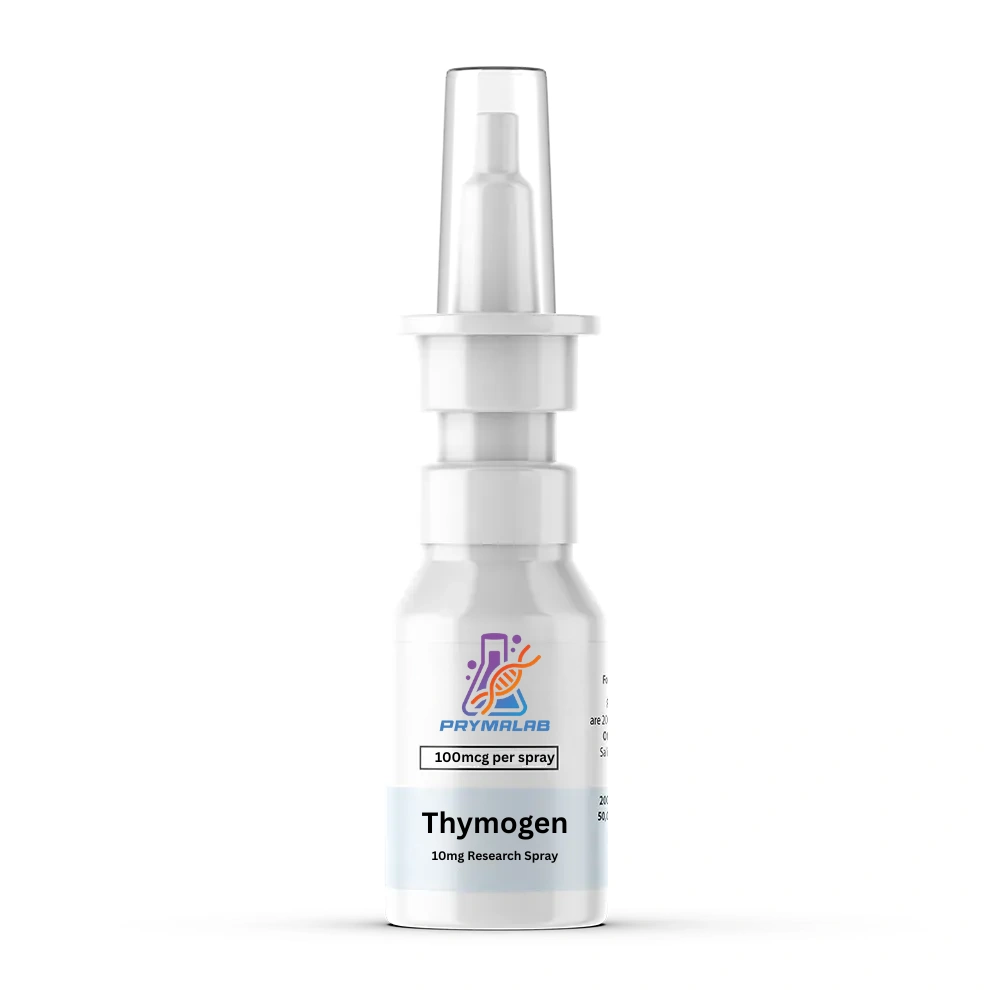
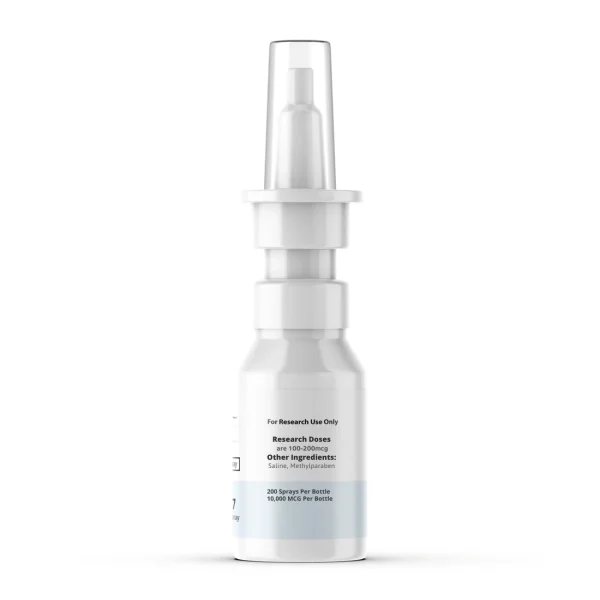
Thymogen Nasal Spray
Glu-Trp dipeptide · 333.35 Da · the only bioregulator with a chromophore
Thymogen nasal spray supplies the dipeptide Glu-Trp in a metered aqueous solution at roughly 333.35 daltons. Half this molecule is tryptophan, which makes it unique among the sixteen bioregulators in two ways that pull against each other: it is the only one you can measure easily, and the only one that degrades in light.
Specification Table
| Property | Value |
|---|---|
| Compound | Thymogen |
| Sequence designation | EW |
| Amino acid sequence | Glutamate-Tryptophan |
| Sequence provenance | Secondary sources, converging. Not traced to a single primary citation. Confirm against the lot certificate before relying on it for calculation |
| Residue count | 2 |
| Molecular weight, calculated | Approximately 333.35 g/mol, computed from standard residue masses plus water |
| Position in the bioregulator family | The only member containing tryptophan |
| Chromophore | Tryptophan. 280 nm absorbance applies, uniquely in this family |
| Oxidation-prone residues | One tryptophan, which is half the molecule by residue count |
| Photolability | Present. The only bioregulator in this catalogue with a photodegradation route |
| Compounds lacking the Glu-Asp core | This compound and Vilon only, of sixteen |
| Near-isobaric relative | Cartalax at roughly 333.31, a difference of about 0.04 daltons |
| Format | Metered nasal spray, solution state |
| Physical state | Aqueous solution, supplied ready to use |
| Purity | Per lot-specific certificate of analysis |
| Storage | 2-8°C, protected from light. Do not freeze |
| Regulatory status | No approved human or veterinary formulation in any jurisdiction |
Why Is Thymogen Nasal Spray the Only Measurable Bioregulator?
Fifteen of the sixteen compounds in this family share a problem that this one does not have.
None of them contains tryptophan, tyrosine or phenylalanine, which means none absorbs meaningfully at 280 nanometres and none can have its concentration read on a spectrophotometer.
For those fifteen, concentration has to come from amino acid analysis, from gravimetry corrected for counterion and water, or from a colorimetric total-peptide assay. All are more laborious than a cuvette reading.
This compound is the exception. A tryptophan gives a strong, well-characterised absorbance at 280 nanometres with an extinction coefficient that is known rather than estimated.
On a solution-state product that matters more than it would on a powder, because a spray arrives at a concentration the buyer did not set and cannot easily verify.
Here they can. A single reading against the calculated extinction coefficient checks the label in about a minute.
That capability is worth using precisely because the same residue makes the concentration a moving target, which is the subject of the next section.
Anyone holding several bioregulator sprays should recognise that this is the one where independent verification of the fill concentration is actually practical.
The extinction coefficient itself is worth a note, since it is the number the whole measurement rests on.
A single tryptophan contributes roughly 5,500 reciprocal molar centimetres at 280 nanometres. That is a large and well-established figure.
For a two-residue molecule that means almost all the absorbance comes from one residue, so the calculation is simpler than for a peptide with several contributing groups.
It also means the reading is sensitive. A modest concentration produces a comfortably measurable signal rather than one buried in baseline noise.
What Does the Tryptophan Cost?
The residue that makes the compound measurable also makes it the least stable member of its family in a solution-state format.
Tryptophan is the least chemically durable of the twenty coded amino acids. Its indole ring absorbs ultraviolet light strongly, and an excited indole is reactive in ways the ground state is not.
Photo-oxidation produces species including N-formylkynurenine and kynurenine, adding oxygen atoms and shifting the mass in increments of 16 and beyond.
Ordinary oxidation driven by dissolved oxygen proceeds without light as well, accelerated by trace transition metals.
At two residues, a single oxidation event modifies half the molecule, which is a larger proportional change than the same event on a longer peptide.
For a product held in water for months in a container opened repeatedly, this is the reaction that actually proceeds, and none of the other fifteen bioregulators has it.
Light protection is therefore a genuine requirement here rather than a generic instruction copied across a product range, and an amber bottle or opaque carton is worth insisting on.
Watch for a species near 349 daltons, representing a single oxygen addition, which is resolvable on any competent instrument if anyone looks.
One more consideration applies specifically to a bottle that is used gradually rather than all at once.
Headspace grows as the bottle empties, which raises oxygen exposure per unit volume and accelerates the reaction over the working life of the product.
A reading taken at the start and another near the end therefore measures something real. The difference between them is itself a useful number.
That kind of before-and-after check costs two cuvettes and is available for this compound and no other in the family.
How Does the 280 Nanometre Reading Detect Its Own Degradation?
The measurement and the degradation involve the same residue, which produces a useful diagnostic and a trap in equal measure.
Oxidised tryptophan still absorbs ultraviolet light, but its absorbance profile shifts rather than disappearing.
A concentration calculated from a single 280 nanometre reading therefore counts oxidised and intact molecules together, and will overstate the intact fraction as degradation proceeds.
Reading the full spectrum rather than a single wavelength is what separates them, since the shape of the curve changes even when the value at 280 does not fall proportionally.
Kynurenine derivatives absorb around 320 to 360 nanometres, a region where intact tryptophan absorbs very little. So a rising reading there is a direct degradation signal.
That gives a cheap monitoring method available to nothing else in this family: scan the bottle periodically and watch the long-wavelength shoulder.
It requires a scanning spectrophotometer rather than a fixed-wavelength reader, which is the only real barrier and not a large one.
Anyone running a study across months on this compound has a way to track its condition without consuming material for a separate assay, which is worth more than it sounds.
What Is the Near-Isobaric Hazard?
One other compound in this catalogue sits within a fraction of a dalton of this one, and the pair is worth knowing about.
Cartalax is Ala-Glu-Asp at roughly 333.31, and this compound is Glu-Trp at roughly 333.35. The gap is about 0.04 daltons.
No ordinary mass spectrometer separates that. A nominal-mass instrument reports 333 for both, and even a good instrument needs to be operating in high-resolution mode to see the difference.
Both compounds are sold in this catalogue, and both are available as sprays, so a supplier running them on shared equipment has a carryover route that mass alone will not detect.
The discriminator is the tryptophan. Cartalax has no chromophore at all. So a 280 nanometre reading distinguishes the two instantly and unambiguously.
That is an unusually clean resolution to an unusually awkward analytical problem, and it costs one cuvette reading.
Chromatographically the two also separate well, since tryptophan is substantially more hydrophobic than the alanine and aspartate Cartalax carries.
Asking a supplier which method they used to distinguish them is a fair question, and one that reveals whether they noticed the coincidence at all.
How Does 333 Daltons Affect the Nasal Route?
This compound sits near the favourable end of the size range for transnasal transport, alongside the other small bioregulators here.
Nasal absorption declines steeply with molecular weight, with the practical transition near 1,000 daltons where passage between epithelial cells stops being efficient.
At roughly 333.35 daltons this compound is well below that boundary, comparable to glutathione at 307.32 and Chonluten at roughly 319.3.
The tryptophan adds substantial hydrophobicity for a molecule of this size, which favours transcellular passage across the lipid membrane as a second route.
That makes this compound unusual among the bioregulators, most of which are hydrophilic and rely on the paracellular route alone.
Charge is modestly negative from the glutamate with no basic residue to offset it, which works against passage of an anion across a negatively charged mucosal surface.
No published study characterises this compound delivered intranasally, so the transport argument rests on structure rather than on measurement.
What Research Position Applies?
The published record concerns the compound rather than the format, and separating those is what keeps a statement defensible.
Work from the St Petersburg programme reports observations in aged rodent models and in cell culture, assessed histologically and through markers of tissue-associated gene expression.
That work used parenteral routes. Nothing in the published literature characterises this compound delivered by the nasal route.
The proposed mechanism, sequence-specific interaction with DNA, remains a hypothesis not independently established outside the originating programme.
No receptor has been identified and no binding constant is on record, so no concentration can be defended from first principles.
This compound is also frequently confused with a differently named preparation in the older literature, which is worth checking when reading a citation.
No independent Western clinical trial of adequate power has been run on this compound, or on any of its fifteen relatives.
How Should Thymogen Nasal Spray Be Stored and Recorded?
One residue governs storage here, and it governs it more strictly than for anything else in the bioregulator range.
The bottle belongs in the dark. That is the primary instruction, and it applies to this compound alone among the sixteen.
Refrigeration at 2 to 8 degrees Celsius applies as usual, and freezing a solution-state product does not.
Limit the number of times the bottle is opened, since oxidation proceeds by dissolved oxygen whether or not light is present.
Avoid metal contact where practical, since trace copper and iron catalyse oxidation of the indole ring.
There is no cysteine, no methionine and no asparagine-glycine motif, so the thiol, thioether and deamidation routes do not apply.
Record the lot, the stated concentration, the 280 nanometre reading taken on receipt, the date first opened, light exposure conditions and the actuation count.
Taking that first spectrophotometer reading on arrival is what makes every later reading interpretable, and it is the single most useful thing a buyer can do with this product.
What Is the Approved Thymogen Product, and Where?
A licensed medicine carrying this name exists, which makes this compound unusual in the bioregulator range and makes the separation worth setting out carefully.
The dipeptide is alpha-glutamyl-tryptophan, built from L-glutamic acid and L-tryptophan, and the medicinal form is the monosodium salt, listed as Thymogen sodium or as glutamyl-tryptophan monosodium salt.
It was developed at the St. Petersburg Institute of Bioregulation and Gerontology and is manufactured by Cytomed, which holds the Russian registration.
It is registered in Russia and in several neighbouring states. It holds no approval in the United States, the European Union or the United Kingdom, and no such product is approved anywhere in the West.
The approved presentations include ampoules of injectable solution prepared with water for injections, and a metered spray, nasal in its route, listed there as Thymogen Spray 10 ml and sold over the counter.
That approved spray is formulated at 0.01 percent with sodium chloride for tonicity and benzalkonium chloride as preservative, which is worth knowing because those excipients are what a nasal formulation of this dipeptide has actually been built with.
Registered indications centre on immunodeficiency states and on infectious and inflammatory diseases, with the compound described as an immunostimulating agent and an immunomodulator.
ARVI, meaning acute respiratory viral infections, is the everyday use, and the approved spray is marketed there for the upper respiratory tract during influenza season.
Other registered uses cover the post-traumatic and postoperative periods, adjunct use alongside antibiotic therapy, and immunosuppression following radiation therapy or chemotherapy, where effects on hematopoiesis are the stated concern.
Regeneration processes in damaged tissue appear in the same registration documents as a secondary claim.
The proposed immunology runs through cellular immunity. Reported effects include a shift in T-helper cells, changes in cytotoxic T-lymphocytes, and a general immune-modulating action rather than blunt stimulation.
Whether that immune-modulating account holds up outside the originating programme is unresolved, since the registration rests on Russian trial data that has not been independently replicated in the West.
This product is not the approved medicine. It is an unapproved research preparation of the same dipeptide, and every indication above belongs to a registered product sold in a different regulatory system.
Nothing here treats influenza, viral and bacterial infections, autoimmune conditions, allergic rhinitis or rhinitis of any kind, and none of it should be taken by anyone.
How Does It Relate to the Other Thymic Peptides?
Several compounds derived from thymus tissue circulate together, and the differences between them matter more than the shared origin.
Thymalin is a polypeptide extract of thymus tissue rather than a defined molecule, and it is the material this synthetic dipeptide was abstracted from.
So Thymalin and this compound are related historically rather than structurally, the same relationship Cortexin has to the brain bioregulators.
Thymosin alpha-1 is a 28-residue peptide from a separate line of work entirely, with a much larger international literature and an approved product in several countries.
Thymosin alpha-1 is the comparison most often drawn and the least apt, since a 28-residue peptide and a two-residue dipeptide have almost nothing in common beyond a thymic association.
Anyone reasoning from thymic peptides generally to this molecule specifically is reasoning across three different kinds of substance.
Does Thymogen Nasal Spray Need Reconstitution?
No. This research compound is supplied as a solution at its fill concentration, so no bacteriostatic water is added and no reconstitution step exists.
Where the dipeptide is sold as a lyophilized powder in a vial, reconstitution belongs to the buyer, and bacteriostatic water is what most buyers reach for.
The counterion question matters more than usual here. If the material is supplied as the monosodium salt rather than the free dipeptide, the mass fraction that is peptide differs, and a concentration calculated without accounting for it will be wrong.
For a compound whose whole analytical advantage is that tryptophan makes it measurable at 280 nanometres, calculating concentration from a weighed mass instead is a wasted opportunity.
Take the reading. It settles the question a reconstitution calculation only estimates.
Thymogen dosage figures circulate widely, drawn from the Russian package insert for the approved product. Those figures describe a registered medicine at a registered strength and do not transfer to this preparation.
Note also that the approved formulation contains benzalkonium chloride, so any comparison between a Thymogen spray bought here and the approved one is a comparison between different formulations as well as different regulatory statuses.
Benzalkonium chloride has itself been studied for effects on ciliated epithelium in the nasal passage, which is a formulation question worth understanding before designing any protocol against nasal mucosa.
Subcutaneous and intramuscular routes appear throughout the parenteral literature for this dipeptide. This is a spray, and it is not injected, not reconstituted, and not given to humans or animals.
Published Literature
Selected references. This literature originates almost entirely from one research programme and used parenteral routes.
- (‘Khavinson VK, Malinin VV. Gerontological Aspects of Genome Peptide Regulation. Basel: Karger; 2005.’, ‘https://doi.org/10.1159/isbn.978-3-318-01193-6’)
- (‘Anisimov VN, Khavinson VK. Peptide bioregulation of aging. Biogerontology. 2010;11(2):139-149.’, ‘https://doi.org/10.1007/s10522-009-9249-8’)
- (‘Simat TJ, Steinhart H. Oxidation of free tryptophan and tryptophan residues in peptides and proteins. J Agric Food Chem. 1998;46(2):490-498.’, ‘https://doi.org/10.1021/jf970818c’)
Frequently Asked Questions
What is Thymogen nasal spray?
A metered aqueous solution of the dipeptide Glu-Trp at roughly 333.35 daltons. Supplied for laboratory research only. No jurisdiction approves it as a human or veterinary formulation.
Why is it the only measurable bioregulator?
Because it is the only one of the sixteen containing tryptophan. The other fifteen carry no aromatic residue at all, so none absorbs meaningfully at 280 nanometres and none can be read on a spectrophotometer.
Why does that matter for a spray?
Because a spray arrives at a concentration the buyer did not set and usually cannot verify. Here a single reading against the calculated extinction coefficient checks the label in about a minute.
What does the tryptophan cost?
Stability. Tryptophan is the least durable coded amino acid, and at two residues a single oxidation event modifies half the molecule, a larger proportional change than on a longer peptide.
How is oxidation detected?
By a species near 349 daltons, representing one oxygen addition. That shift is resolvable on any competent instrument if someone looks for it.
Does oxidation affect the 280 reading?
Yes, and misleadingly. Oxidised tryptophan still absorbs, so a single-wavelength reading counts oxidised and intact molecules together and overstates the intact fraction as degradation proceeds.
Is there a better method?
Scan the full spectrum rather than reading one wavelength. Kynurenine derivatives absorb around 320 to 360 nanometres where intact tryptophan absorbs little, so a rising shoulder there is a direct degradation signal.
What is the near-isobaric hazard?
Cartalax sits at roughly 333.31 against this compound at roughly 333.35, a gap of about 0.04 daltons that no ordinary mass spectrometer separates. Both are sold in this catalogue.
How are they distinguished?
By the tryptophan. Cartalax has no chromophore at all, so a 280 nanometre reading separates the two instantly. Chromatography also works, since tryptophan is substantially more hydrophobic.
How does its size affect nasal transport?
At roughly 333.35 daltons it sits well below the 1,000 dalton transition. The tryptophan also adds hydrophobicity unusual among the bioregulators, which favours transcellular passage as a second route.
What is the most useful thing to do on receipt?
Take a 280 nanometre reading immediately. That first measurement is what makes every later one interpretable, and it is available for this product and no other bioregulator here.
Is Thymogen an approved medicine?
A product with this name is registered in Russia and several neighbouring states, manufactured by Cytomed, sold as ampoules and as a 10 ml spray. It holds no approval in the US, EU or UK. This is not that product; it is an unapproved research preparation of the same dipeptide.
What is the approved product used for there?
Immunodeficiency states and infectious and inflammatory diseases, with everyday use in ARVI. Other registered uses cover the post-traumatic and postoperative periods and immunosuppression after radiation therapy or chemotherapy. Those indications belong to the registered medicine.
How does Thymogen peptide affect the immune system?
The proposed account runs through cellular immunity, with reported shifts in T-helper cells and cytotoxic T-lymphocytes and an immune-modulating rather than blunt stimulating action. It rests on Russian trial data never independently replicated in the West.
How does it differ from Thymalin or thymosin alpha-1?
Thymalin is a thymus tissue extract rather than a defined molecule, so it relates to this dipeptide historically. Thymosin alpha-1 is a 28-residue peptide from separate work with a far larger literature. A two-residue dipeptide has little in common with either.
Does Thymogen nasal spray need reconstitution?
No. It ships as a solution, so no bacteriostatic water is added. Where it is sold as a lyophilized powder, note that a monosodium salt has a different peptide mass fraction than the free dipeptide, and the 280 nanometre reading settles what a weighing only estimates.
What does the approved formulation contain?
The registered spray is 0.01 percent with sodium chloride for tonicity and benzalkonium chloride as preservative. Benzalkonium chloride has been studied for effects on ciliated epithelium, and allergic reactions to preservatives are a known formulation issue. This preparation is not that formulation.
Compliance Statement
Thymogen nasal spray is sold exclusively for laboratory research use. It is not a drug, food, or cosmetic product, and it is not a dietary product of any kind. It is not approved by the FDA or any comparable authority for human or veterinary use, its proposed mechanism has not been independently established, no published study characterises this compound delivered intranasally, and the research record concerns parenteral administration. This product is not intended to diagnose, treat, cure, or prevent any disease. It must not be given to humans or animals. Purchase is restricted to qualified researchers and institutions operating within applicable laws. All handling is the responsibility of the purchasing laboratory.
Other formats of Thymogen
Thymogen is also stocked as Thymogen 10mg preloaded 3ml pen and Thymogen Peptide 20mg. Each listing states its own quantity and concentration, and the pen and vial comparison explains what changes between formats.


5 reviews for Thymogen 10mg Nasal Spray